For much of the recent AI cycle, progress was described through individual models. A new release arrived with a larger context window, stronger reasoning, better coding performance or a new benchmark result, and applications were designed around whichever model appeared strongest for the job.
That architecture is already changing.
As the model landscape has become more diverse, it has become increasingly obvious that different tasks benefit from different types of models. Fast models are useful for routine classification and extraction, coding-oriented models may perform better inside software workflows, multimodal models can interpret visual input, and stronger reasoning models can be reserved for the parts of a workflow where deeper inference actually matters.
That gave rise to model routing: a layer that sits between the application and the available models and decides where each request should go.
Agents push the same idea further. An agent does not usually make a single inference call and stop. It moves through a sequence of steps: gathering context, inspecting files, querying tools, planning, executing, validating, retrying and sometimes escalating when a previous attempt fails. There is little reason to assume that every step in that sequence should use the same model.
This is the problem NVIDIA is addressing with NeMo Switchyard, where routing decisions can happen throughout an agent’s execution rather than only once at the application boundary.
But the more significant architectural shift begins when routing no longer applies only to models.
Instead of asking which model should handle this request?, the system can ask a broader question:
Which model, agent, tool or external capability is best suited to this part of the problem, and how should those capabilities work together?
That is where the idea of an AI Mesh Network starts to become useful.
The progression is less about replacing one technology with another and more about expanding the level at which intelligence is organised:
The centre of gravity gradually moves away from the model itself and toward the architecture surrounding it.
That is why the next phase of AI engineering may be less about model intelligence and increasingly about system intelligence.
AI Mesh Networks: intelligence as a network
An AI Mesh Network is not simply a collection of models running next to one another.
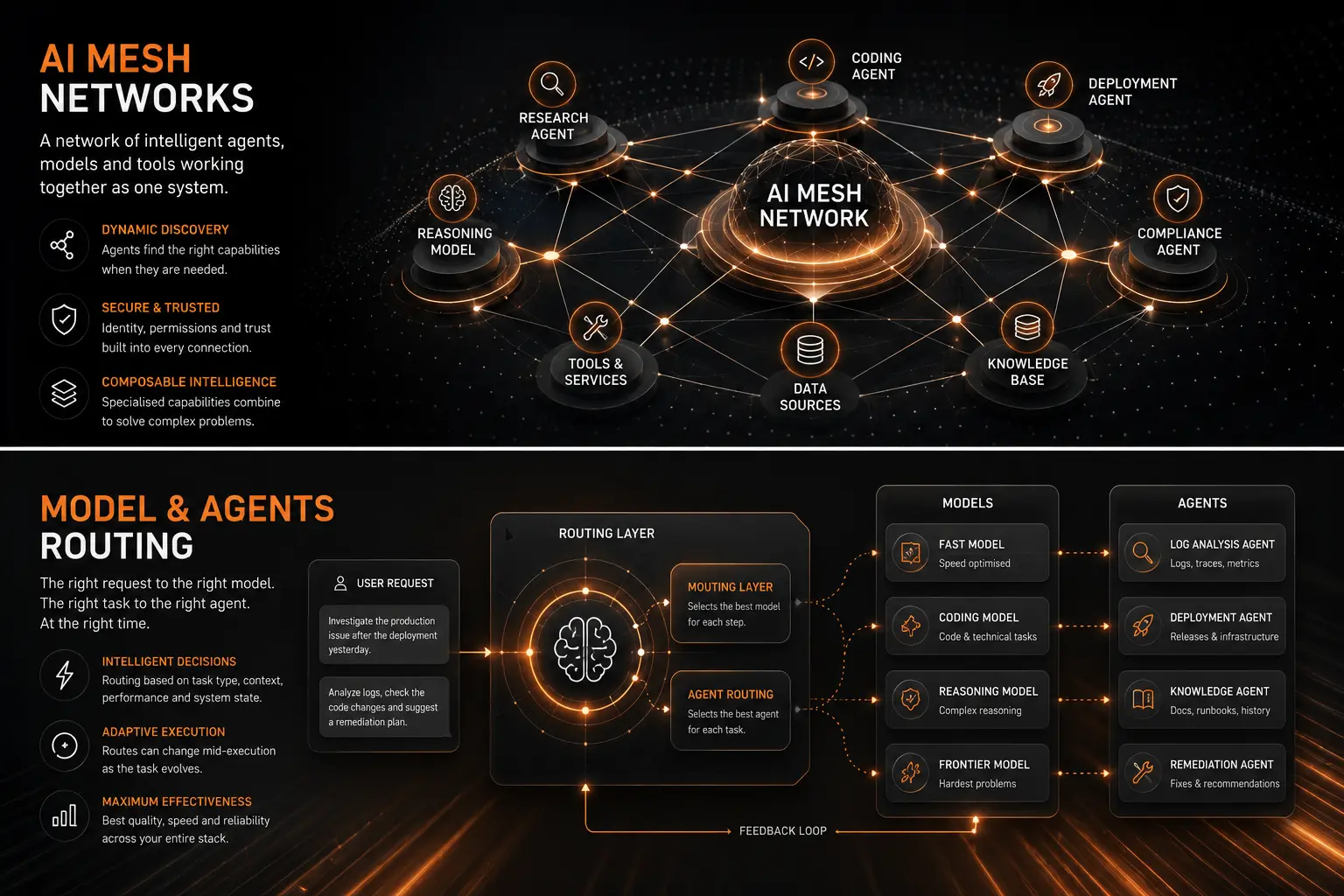
It is better understood as a distributed environment in which specialised models, agents, tools and services can be discovered, selected and coordinated according to the problem being solved.
Consider a request entering an enterprise AI system:
The interesting part is not the number of components. The interesting part is that each component can carry a different responsibility, security boundary, data source and model while still participating in the same workflow.
A research agent may have access to the public web and internal documentation. A deployment agent may be able to inspect Kubernetes state and release metadata. A code agent may have repository access but no access to customer information. A verifier may receive the outputs of all three while deliberately being prevented from modifying anything.
The result is not simply “multiple agents.” It is an architecture in which intelligence becomes composable.
For people who have worked with modern infrastructure, the shape should feel familiar.
Software systems moved from large monolithic applications toward smaller services, then toward distributed platforms where discovery, networking, identity, observability and policy had to be treated as infrastructure rather than application-specific logic.
The progression looked roughly like this:
AI appears to be moving through a comparable architectural expansion:
The analogy is not perfect, but it is useful because it highlights where the real engineering challenge moves.
Once intelligence becomes distributed across many components, the difficult questions are no longer only about inference quality. They become questions of coordination, discovery, identity, routing, trust, failure handling and observability.
That is precisely where the AI mesh idea becomes more than another name for multi-agent systems.
Why this architecture is useful
Take a fairly normal enterprise task:
Analyse this customer incident, inspect the application logs, determine whether it relates to yesterday’s deployment, check the relevant internal documentation and propose a remediation plan.
A single general-purpose model could attempt the entire workflow, but the task itself is already composed of several different technical domains.
A mesh-oriented system could decompose it more naturally:
The log-analysis agent could focus on traces, exceptions and timing anomalies. The deployment agent could compare current behaviour against recent commits, release notes and cluster changes. The internal knowledge agent could search runbooks, historical incidents and architecture documentation. The verification agent could compare the evidence and identify where the conclusions agree or conflict.
This matters because each participant can be designed around the task it actually performs.
The log-analysis agent does not need broad access to corporate data. The deployment agent may need repository and infrastructure access but no CRM data. The verifier may require broad visibility into results while having no execution permissions at all.
Each component can therefore operate with its own:
- model;
- tools and APIs;
- context;
- permissions;
- data sources;
- memory;
- execution limits;
- security policies;
- latency and cost profile.
This is a more meaningful form of modularity than simply sending several prompts to several models.
The mesh becomes a way of structuring who can do what, with which information, under which constraints, and in collaboration with whom.
What makes it a mesh rather than a workflow?
Many systems described today as multi-agent systems are still deterministic pipelines.
Agent A calls Agent B. Agent B calls Agent C. The topology is known in advance and usually encoded directly in application logic.
That is useful orchestration, but it is not yet much of a mesh.
A mesh becomes more interesting when participants can advertise their capabilities, be discovered dynamically and become part of a workflow only when their expertise is needed.
Instead of:
the architecture begins to look more like:
Imagine that Agent A receives a task involving a security issue it cannot resolve confidently. Rather than calling one hard-coded endpoint, it could search for agents that expose relevant security-analysis capabilities, compare their metadata or trust level, delegate part of the task, receive structured output and continue from there.
Another workflow might require a regulatory agent, a financial-data agent and a code-execution agent. Those three agents may never have worked together before. They are assembled because the task requires that combination.
The team exists for the duration of the task and then effectively disappears.
That dynamic composition is where the word mesh starts to become meaningful.
It is also where infrastructure becomes essential.
Model routing: a narrower but more mature layer
Model routing is related to this architecture, but it solves a much more specific problem: a model router decides which model should process a particular request or step.
The router may consider several dimensions at once: task type, latency, context length, model availability, recent failure rate, price, or expected quality. A routine extraction task might go to a compact model, while a large repository-analysis task might go to a coding-oriented model with a suitable context window. A difficult reasoning problem might be escalated only after a smaller model fails to make progress. This idea has already moved into production infrastructure.
LiteLLM, for example, provides a unified gateway across a large range of model providers and exposes capabilities such as load balancing, fallbacks, budgets and routing. Applications can communicate through one interface while the gateway handles provider-specific differences behind the scenes.
OpenRouter takes a related approach at the model-access layer, giving applications one interface across a large model ecosystem while abstracting provider selection, availability and routing behaviour.
OmniRoute approaches the problem from a more self-hostable direction, exposing an OpenAI-compatible layer that can route between multiple providers and manage fallback behaviour and quotas. Its emerging support around MCP and A2A is especially interesting because it hints at a larger convergence: the component that routes requests between models may increasingly sit next to the infrastructure that connects agents and tools.
Despite their different implementations, these systems share the same architectural principle:
The application should not need to be permanently coupled to one model. Model selection can become an infrastructure decision.
That is an important shift, but it is still not an AI mesh.
Agent routing makes model routing more interesting
Model routing becomes more valuable once the caller is an autonomous agent. A conventional application might make one or two model calls for a user request; an agent may make dozens.
Consider a coding task:
These are very different workloads even though they belong to the same task. Repository exploration may involve many low-complexity calls where speed matters more than deep reasoning, while understanding an architectural bug may require a stronger model. Applying a mechanical edit may once again be relatively straightforward, and a failed test could then trigger escalation. If every stage is sent to the same model, the system loses the opportunity to allocate intelligence more intelligently. This is the idea behind NVIDIA NeMo Switchyard.
NVIDIA NeMo Switchyard
NeMo Switchyard is designed around model routing for agentic workloads, where routing can happen repeatedly during the execution of one task rather than only at the beginning. The routing layer sits between the agent and the underlying models, so the agent itself does not need hard-coded logic for every provider or model decision. A workflow might begin with a smaller model, monitor progress and escalate when the system detects that the current model is no longer producing useful progress.
Conceptually:
That pattern is more interesting than a simple “cheap model versus expensive model” comparison because the routing decision becomes stateful. The system can decide not only from the incoming prompt, but also from what has already happened during execution: Did the model fail twice? Has the task entered a debugging stage? Did the token count increase sharply, or did the output contain a recognisable error pattern? Is the agent now operating in a stage that historically benefits from a stronger model?
Once those signals are available, routing becomes part of the agent runtime rather than merely an API-gateway feature. This is likely to become an important component of future agent infrastructure, but it should be evaluated against real workloads rather than treated as an automatic optimisation. Its value depends on whether simpler steps can genuinely be handled by smaller models and whether the router can identify difficult steps accurately enough to make escalation worthwhile.
Model routing and AI Mesh are not the same thing
Because both ideas involve dynamic selection, they are sometimes discussed as though they belong to the same category. They do not.
| Model Routing | AI Mesh |
|---|---|
| Selects an LLM | Connects intelligent systems |
| Operates across models | Operates across agents and capabilities |
| Optimises inference | Coordinates work |
| Usually sits inside one application stack | Can span multiple systems and organisations |
| Focuses on latency, quality and efficiency | Focuses on discovery, delegation, identity and trust |
| Models are resources | Agents become participants |
A router may decide:
Use Model B for this step.
A mesh may decide:
Ask the security agent to investigate the authentication failure, ask the deployment agent to inspect the latest release, retrieve historical incidents from the knowledge agent, and send all three results to a verifier.
That distinction is important because model routing is likely to become one layer inside the mesh architecture rather than an alternative to it.
A2A: the communication layer between agents
If independently developed agents are going to participate in the same network, they need a common way to communicate. This is where Agent2Agent, or A2A, becomes particularly important. A2A is an open protocol designed to let agents communicate and collaborate without requiring them to share the details of how they are implemented internally.
That separation matters. Agent A does not need access to Agent B’s prompts, memory implementation, orchestration framework or internal tools; it needs to know what Agent B can do, how to communicate with it, how to send a task, how to follow the state of that task and how to receive the result.
Conceptually:
This becomes increasingly important once agent systems move outside the boundaries of one application. A company may expose a specialised procurement agent, another organisation a logistics agent, and a third a compliance agent. Those agents should not need to run on the same framework—or even the same cloud—to collaborate. They need an interoperable contract, and that is the role A2A is beginning to define.
A2A and MCP solve different layers
A2A becomes clearer when it is placed next to the Model Context Protocol, or MCP. MCP gives an AI system a standard way to connect to tools and data, while A2A gives one agent a way to communicate with another agent. The distinction is simple:
MCP connects intelligence to capabilities
A2A connects intelligence to intelligence
Used together, the architecture starts to resemble the foundation of an actual mesh:
An agent can use MCP to access its own capabilities while using A2A to delegate work to another agent with a different set of capabilities. Together, these layers are much more powerful than either one on its own.
The emerging agentic infrastructure stack
Once these pieces are combined, the architecture becomes easier to see.
No single product owns this architecture, and no single protocol solves every layer. That is exactly why the current moment is interesting.
Several pieces are maturing at the same time: specialised models, model gateways, routing layers, agent runtimes, MCP-based tool ecosystems, A2A interoperability, agent discovery, identity systems, observability, distributed inference and enterprise governance. Individually, each development may look incremental; taken together, they begin to resemble the foundations of an agentic infrastructure stack.
That is the broader significance of AI Mesh Networks. The mesh is not necessarily one new framework; it may instead emerge from the interaction of several infrastructure layers that gradually become interoperable.
The difficult problems are infrastructure problems
Once agents can communicate dynamically, the difficult engineering questions change quickly.
- Discovery: An agent needs a reliable way to determine which other agents exist, what capabilities they expose and whether those capabilities are currently reachable.
- Identity: A system must be able to confirm that an agent really represents the organisation or service it claims to represent.
- Authorisation: Delegation must not automatically transfer every permission held by the delegating agent.
- Trust: Several agents may produce different answers, use different sources or disagree about what should happen next.
- Observability: One user request may fan out into dozens of model calls, tool invocations and agent-to-agent interactions across several systems.
- Failure handling: An agent may disappear midway through execution, a dependency may become unavailable or a delegated task may return incomplete state.
- Cost control: An autonomous agent capable of recursively delegating work can generate substantial computational or API activity.
- Governance: Cross-organisational agents may take actions on behalf of people or companies, making policy and accountability unavoidable.
None of these problems is solved by releasing a model with a slightly higher reasoning score. They require infrastructure, and that is perhaps the most important point in the whole discussion.
Why 2027 matters
AI Mesh Networks are still an architectural direction rather than a finished product category. The terminology is not settled, implementations vary considerably, and many systems described as “agent networks” are still centrally orchestrated workflows underneath. But several prerequisites for a genuine mesh are now developing simultaneously: model routing is already usable, agent-level routing is becoming more sophisticated, MCP is providing a common interface between agents and tools, A2A is establishing a protocol for communication between independently built agents, and discovery, identity, gateways and observability are becoming first-class concerns.
The interesting question for 2027 is therefore not whether someone releases a product called “AI Mesh 1.0,” but whether these layers begin to converge into a coherent and interoperable architecture. If they do, the way we design AI systems may change substantially.
Applications will no longer need to be built around one model, and agents will not necessarily be confined to one application. Capabilities may become discoverable, model choice may become dynamic, and agent composition may happen at runtime. External intelligence may become callable in much the same way that software services are callable today. That is a much larger architectural shift than another improvement in model benchmarks.
From model intelligence to system intelligence
For several years, AI development was dominated by the performance of individual models. Parameter count, benchmark scores, context length and reasoning capability became the natural language of comparison. Those measurements still matter, but they increasingly describe only one layer of the system.
The quality of a serious AI application now depends on a much broader set of components: retrieval, memory, tool access, context management, routing, permissions, orchestration, verification, observability and specialised agents. A powerful model inside a poorly designed system can still perform badly, while a smaller model inside a carefully engineered system can be highly effective because the surrounding architecture provides the context, tools and constraints it needs.
The unit of innovation is therefore expanding: first the model, then the AI system, and increasingly the AI network.
There is a useful analogy with the development of the Internet. A computer became dramatically more useful once it could communicate with other computers, and a service became dramatically more useful once it could call other services reliably. AI agents may follow the same pattern.
An isolated agent can already be capable, but a network of interoperable agents that can discover expertise, exchange information, delegate work, access external tools and dynamically select the right model for each stage is something more significant. That is the promise behind AI Mesh Networks.
Final thoughts
We are not at the fully realised AI-mesh stage yet. Model routing is already practical, agent-level routing is becoming real, and open protocols such as MCP and A2A are beginning to provide the interfaces needed for larger ecosystems. At the same time, identity, discovery, trust and observability are emerging as the next infrastructure problems that need to be solved.
The sensible approach is not to build an enormous autonomous network simply because the architecture sounds compelling, but to start with the layers whose value is already clear. Use routing where different models genuinely serve different stages of a workflow, and use MCP where standardised tool access simplifies the system. Define agent boundaries around real capabilities rather than artificial personas, and use A2A where independently built agents actually need to collaborate. Identity, permissions, tracing and governance should be part of the architecture from the beginning—not retrofitted once the system becomes complex.
The most interesting question heading into 2027 may therefore no longer be:
Who has the smartest model?
It may increasingly become:
Who can build the most effective system of models, agents and capabilities — and make all of those pieces work together reliably?
That is where the harder engineering problems are moving. Perhaps the cleanest way to summarise the distinction is still this:
Model routing finds the right brain for a task. An AI Mesh connects many brains, agents and tools so they can operate as a system.
References
- NVIDIA, Route AI Agent Workloads Across Models with NVIDIA NeMo Switchyard, NVIDIA Technical Blog, August 2026.
- NVIDIA, Nemotron 3.5 Lightning and NeMo Switchyard Deliver Faster, Smarter, More Efficient Agentic AI, August 2026.
- Agent2Agent (A2A) protocol specification and documentation.
- Model Context Protocol specification and documentation.
- VE3, Manish Garg, From LLMs to AI Mesh Networks: The Next Evolution in Model Architecture, April 2025.
- Berkeley AI Research, The Shift from Models to Compound AI Systems, 2024.
Useful links
- NeMo Switchyard — developer.nvidia.com
- A2A Protocol — a2a-protocol.org
- Model Context Protocol — modelcontextprotocol.io
- LiteLLM — litellm.ai
- OpenRouter — openrouter.ai
- OmniRoute — omniroute.online
Written by Patryk Kozak. Designing multi-model or multi-agent systems — from routing strategy and A2A/MCP integration to the discovery, identity and observability layers behind agentic infrastructure — and want to exchange ideas? Get in touch.